
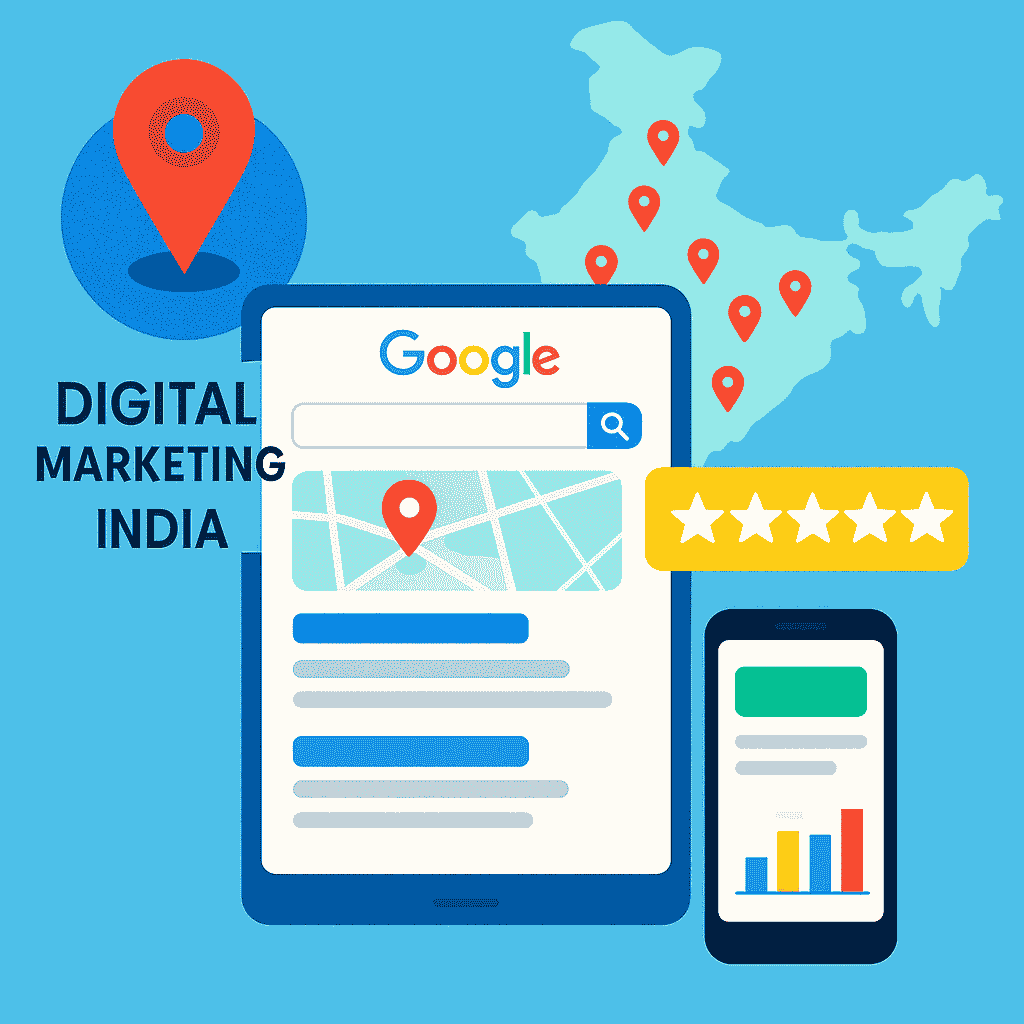
Top Local SEO Techniques for Indian Businesses in 2025
Local SEO is essential for Indian businesses to stand out in “near me” searches and attract nearby customers. In this guide, we cover effective local SEO techniques – from optimizing your Google My Business profile and targeting local keywords to managing online reviews and mobile-friendly design – to boost your local online presence. These strategies will help your business appear prominently in local Google results, drive more calls and visits, and outshine competitors in your area.
Why Local SEO Matters for Indian Businesses
Local SEO (Search Engine Optimization) is the practice of optimizing your online presence to attract more business from relevant local searches. These are searches that include location-specific terms (like city names or “near me” queries) or are made by users located near your business. Mastering local SEO is crucial for Indian businesses because consumer behavior is increasingly location-focused. Nearly 46% of all Google searches have local intent– for example, someone searching for “digital marketing agency near me” – and local searches often lead to real sales. In fact, 78% of local mobile searches result in an offline purchase within 24 hours. With 9 out of 10 internet users in India accessing the web via smartphones, appearing in mobile “near me” searches can directly translate into foot traffic and phone inquiries for your business.
Local SEO is essentially about making sure your business is visible when nearby customers search for services you offer. This visibility includes showing up in Google’s Local Pack (the map and 3 top listings), Google Maps results, and localized organic results. Compared to broad national SEO, local SEO is often more cost-effective and targeted – it helps you reach people who are likely to convert quickly. Done right, it can reduce the need for expensive ads by driving more walk-ins and calls organically.
Optimize Your Google My Business (Google Business Profile)
Google My Business (Google Business Profile) is a free tool that puts your business on the map – literally. Optimizing your GMB profile helps you appear in local search results and on Google Maps, making it easier for nearby customers to find you and engage with your business.
The first (and arguably most important) step in local SEO is claiming and optimizing your Google My Business (GMB) profile, now called Google Business Profile. GMB is a free listing that appears when users search for your business or related services in your area. It displays your address, map location, phone number, website, photos, reviews, and more. As a business owner – or with the help of a Google My Business services provider – you should claim your GMB listing and fill it out completely. A complete and verified GMB listing significantly boosts your local visibility and credibility. In fact, customers are 2.7× more likely to consider a business reputable if it has a complete Google Business Profile, and businesses with complete profiles are 70% more likely to attract location visits from searchers.
Here are key tips to optimize your GMB profile:
Provide Accurate Information: Ensure your business Name, Address, and Phone number (NAP) are correct and consistent. Choose the most appropriate business categories and add your website, operating hours, and other details. Consistency is critical – your GMB info should match exactly what’s on your website and other listings to build trust with Google’s algorithms.
Write a Descriptive Introduction: Craft a clear business description that includes relevant local keywords (e.g., your city, neighborhood, and services). This helps Google understand your relevance to local queries. For example, mention if you’re a “digital marketing agency in Ahmedabad” or “Mumbai organic bakery” as part of your description (if that’s your business type).
Add Photos and Videos: Profiles with photos get more engagement – Google reports that listings with photos receive 42% more requests for directions and 35% more clicks to their websites. Upload high-quality images of your storefront, interior, products, or team. For instance, a restaurant might share photos of its dishes and ambiance, while a salon might show before-and-after client photos. Visual content makes your listing more appealing and helps customers trust that your business is legitimate.
Collect and Manage Reviews: Encourage your happy customers to leave positive Google reviews, as they directly impact your local ranking and reputation. Respond to reviews promptly – thank customers for positive feedback and professionally address any negative comments. Businesses with higher ratings and responsive owners tend to attract more clicks. (Many consumers always read reviews – about 75% regularly check online reviews when evaluating local businesses.) A strong rating (and how you handle feedback) can be the deciding factor for a potential customer choosing you over a competitor.
Use GMB Posts and Updates: Google allows you to publish updates (offers, events, news) via your Business Profile. Take advantage of these GMB posts to share timely content – for example, a weekly special, a holiday greeting, or a new blog post. Regular updates keep your profile fresh and engaging, and they can prompt more actions from viewers.
Leverage Q&A and Messaging: Monitor the Questions & Answers section on your GMB listing. Proactively answer common questions about your services (e.g., “Do you offer home delivery?” or “Is parking available?”) so that users see helpful info right on your listing. Enable messaging (if suitable) so customers can contact you directly from the listing.
Optimizing GMB can yield dramatic results. For example, after a Jaipur dental clinic fully optimized its Google My Business profile – adding correct hours, 15 high-quality photos, weekly posts about dental tips, and responding to every review – the clinic saw a 61% increase in calls from Google Search and a 44% increase in direction requests on Google Maps within 3 months. This real-world case shows how powerful GMB optimization can be in driving local customer actions.
Interlink: Need help with Google My Business setup and optimization? As a leading Google My Business services provider in India, we offer GMB profile creation and management as part of our Local SEO Services to ensure your listing becomes a magnet for local customers.
Target Local Keywords in Your Website Content
Optimizing your website for local search is the next major component of local SEO. Think about what your potential customers might search for when looking for your services in your area. These search terms often combine a service or product with a location, e.g., “wedding photographer Delhi” or “best street food in Chennai”. Conduct local keyword research to identify high-traffic phrases relevant to your business and location. Tools like Google Keyword Planner or SEMrush can help, or simply use Google’s autocomplete and “People also ask” suggestions for ideas.
Once you have your target keywords, strategically incorporate them into your website:
On-Page SEO: Include local keywords in key spots like your page titles, meta descriptions, headers, and body content. For instance, a bakery in Ahmedabad might have a title like “Artisan Bakery in Ahmedabad – Fresh Breads & Cakes” on its homepage. If you serve multiple cities or neighborhoods, consider creating dedicated landing pages for each area (e.g., an HVAC company might have separate pages for “AC Repair in Bandra” and “AC Repair in Andheri”). This way, each page can be optimized for its specific local.
Content Marketing with a Local Angle: Regularly publish blog posts or articles that focus on local topics. This could be guides, tips, or news relevant to your city or industry. For example, a travel agency might blog about “Top 10 Attractions to Visit in Cochin” or a boutique might write “How to Choose a Bridal Lehenga in Delhi’s Chandni Chowk”. Such content not only incorporates local keywords naturally but also establishes your expertise in the local context. Don’t shy away from weaving in culturally relevant topics, local events or festivals, and customer success stories from your region – this hyperlocal content can resonate with your audience and improve local relevance.
Use Schema Markup: For more advanced on-page optimization, implement local schema markup (structured data) on your website. Adding LocalBusiness schema tags with your business’s name, address, phone, hours, and other details helps search engines better understand your location information. This can increase your chances of appearing in rich results (like the Local Pack or info panels) with accurate details.
Website UX for Local Users: Ensure that important info for local visitors is easy to find on your site. Have a clear Contact Us page with your address (and an embedded Google Map), phone number, and directions. Highlight your service areas or store locations prominently. A user who lands on your site from a local search should instantly see that you serve their area and how to reach you.
By aligning your site content with local search terms and providing valuable local information, you make it much easier for both Google and local customers to see that you’re a relevant answer to their query. This on-site optimization works hand-in-hand with your GMB efforts to reinforce your local presence.
Interlink: For a detailed look at on-page optimization and local content strategy, see our Local SEO Services page, where we outline how we tailor website content to capture local search traffic.
Build Citations and Local Business Listings
Beyond Google My Business, another core local SEO technique is building citations – which are mentions of your business’s NAP (Name, Address, Phone) on other websites. These usually take the form of listings on online directories, business listing sites, or industry-specific platforms. Citations and backlinks from local sites signal to search engines that your business is established and relevant in a certain geography, thereby boosting your local rankings.
To strengthen your citation profile:
List Your Business on Popular Directories: Ensure your business is listed on major platforms like Google Maps, Facebook, and Bing Places. Additionally, in India, take advantage of high-traffic local directories such as JustDial, Sulekha, IndiaMart, Yelp India, and Yellow Pages. These platforms are commonly used by Indian consumers to find local services. Register your business on these sites and make sure your NAP and other details (category, website, etc.) are accurate and consistent across all of them.
Use Industry-Specific Directories: Depending on your field, there may be specialized listing sites (for example, Zomato for restaurants, Practo for healthcare providers, UrbanPro for tutors, etc.). Get your business added to any reputable niche directories or marketplaces relevant to what you do. This not only improves SEO but also directly puts you in front of users searching those platforms.
Maintain NAP Consistency: Consistency cannot be stressed enough – your Name, Address, Phone number should appear exactly the same everywhere online. Even minor differences (like “Road” vs “Rd.” or using different phone formats) can confuse search algorithms or dilute trust. Take time to audit your existing listings and correct any discrepancies. A uniform presence builds credibilityand helps avoid confusion for customers too.
Local Citations and Backlinks: Look for opportunities to get mentioned on other local websites. This can include local news sites, community blogs, chamber of commerce pages, or partner business sites. Sometimes sponsoring a community event or participating in local charities can earn you a mention (and link) on their websites. For example, if you sponsor a local marathon, the event website might list your business as a sponsor (providing a citation/backlink). Such local backlinks carry weight, as they signal your engagement in the community.
Geotag on Social Platforms: In addition to directories, utilize social media for citations. Consistently use location tags on platforms like Instagram or Facebook when you post content about your business. If your business has physical premises, encourage customers to “check-in” on Facebook or tag your location in their posts. These social signals can indirectly support your local SEO by increasing awareness and local mentions.
Building and managing citations can be time-consuming, but it’s a foundational aspect of local SEO. It creates a web of references to your business across the internet, reinforcing to Google that “this business is active and located in X area, and here’s how you contact them.” Strong citation building combined with GMB optimization greatly improves your chances of showing up in the Local Pack and map results when someone nearby searches for your services.
Interlink: Our team covers citation building as part of our Local SEO Services, ensuring your business is listed on all pertinent platforms with consistent information. Visit our services page to learn how we help you secure and manage these local listings for maximum SEO benefit.
Encourage and Manage Customer Reviews
Online reviews and ratings are the lifeblood of local business reputation – and they heavily influence SEO as well as customer behavior. Positive reviews not only make your business more appealing to potential customers, but they also send signals to search engines about your trustworthiness and prominence. Google’s local ranking algorithm considers the quality and quantity of reviews on your GMB profile (and elsewhere) as a factor in determining where to rank you in local results.
Here’s how to leverage reviews for better local SEO:
Ask for Reviews: Develop a process to politely ask satisfied customers to leave a review on your Google Business Profile (and other platforms like Facebook or industry-specific review sites). Often, customers are happy to do this if asked – you might do so at the end of a sale, in a follow-up email, or via a WhatsApp message with a direct link to your review page. Remember, the volume of reviews matters: businesses that rank higher typically have numerous recent positive reviews.
Earn High Ratings: While you should never buy or fake reviews (that can backfire and violate policy), you should absolutely strive for great customer experiences that naturally lead to 5-star ratings. Even a small improvement in your star rating can impact consumer perception – for example, a company with 4.3 stars tends to attract more clicks than one with 4.0 stars, even if both appear in the same search results. High average ratings can also improve your chance of being featured in the Google local 3-pack.
Respond to Reviews (Both Good and Bad): Be active in managing your reviews. Thank customers who leave positive feedback – it shows you value your customers. Equally important, address negative reviews constructively and promptly. A thoughtful response to a complaint (offering to resolve the issue or apologizing for a mistake) can actually impress onlookers. According to consumer surveys, 89% of people are more likely to choose a business that responds to all reviews (not just the positive ones) because it demonstrates professionalism and care. By engaging with reviews, you also keep your GMB profile fresh and show Google that the business is active.
Diversify Your Reviews: While Google is the priority, note that reviews on other platforms (Facebook recommendations, JustDial ratings, TripAdvisor, etc.) can also bolster your overall local SEO footprint. People often check multiple sources. Encourage reviews on platforms that matter in your industry. For example, a hotel will want TripAdvisor and Google reviews; a contractor might gather testimonials on JustDial or Sulekha in addition to Google.
Highlight Reviews in Your Content: Showcase some glowing customer testimonials on your website (with permission). This not only provides fresh content (good for SEO) but also reinforces trust to site visitors. You can also share or quote reviews on social media, further amplifying positive word-of-mouth.
Remember, consistent review acquisition and management is an ongoing process. Make it part of your customer service routine. Not only will a strong review profile improve your local rankings – it will also directly increase conversion rates as new customers see proof of your quality. In local SEO, reputation is everything.
Optimize for Mobile Search and Voice Queries
A huge proportion of local searches happen on mobile devices, as people on-the-go look up businesses nearby. We’ve already noted that India’s internet users are predominantly mobile, and that local mobile searches convert at a high rate. Thus, ensuring your online presence is mobile-friendly is non-negotiable:
Mobile-Friendly Website: Your website should be responsive (adapts to all screen sizes) and fast-loading on mobile networks. Google prioritizes mobile-friendly sites in mobile search rankings (mobile-first indexing). Use Google’s Mobile-Friendly Test or PageSpeed Insights to check your site’s performance. Simple things like optimizing images, enabling browser caching, and using a reliable hosting can improve load times. A smooth mobile user experience (easy navigation, readable text, clickable phone links for “Call now”, etc.) can keep visitors on your site longer and lead to more conversions (like calls or form inquiries).
Click-to-Call and Maps Integration: Make it effortless for mobile users to contact or find you. Include a prominent “Call” button on your site (especially for smartphone users) and ensure your address is linked to Google Maps. Many local customers will want to call immediately or get directions when they find you – cater to these needs with one-tap functionalities.
Voice Search Optimization (Answer Engine Optimization): With the rise of Siri, Google Assistant, Alexa and others, more people are using voice queries to find local information. Voice searches are often conversational and question-based – e.g., “Where is the nearest car repair shop?” or “Which cafe is open now near me?”. In fact, 72% of consumers use voice assistants to search for local businesses and 76% of voice searches include “near me” or other location phrases. To capture these, optimize your content for Answer Engine Optimization (AEO):
Incorporate natural language questions and answers on your site. A great way is to add an FAQ section on your homepage or relevant service pages, addressing common queries. For example, if you’re a clinic, include Q&As like “What are your opening hours on weekends?” or “Do you offer home visits in Kolkata?” and answer them clearly.
Use long-tail keywords that mirror how people speak. Someone might voice-search “best budget hotel near Mumbai airport” rather than typing “budget hotel Mumbai airport”. Try to include such phrasing in your content if it fits.
Make sure your content answers questions succinctly, as voice assistants often pull brief answers from websites (featured snippets) to read out to users. Structuring a paragraph that directly answers a specific question can improve your chances of being picked up as a voice result.
Local Language Content: In India, many voice searches (and even typed queries) happen in local languages or a mix of English and local language (e.g., Hinglish). If your audience is multilingual, consider providing content in the relevant language or bilingual content. For instance, a local coaching center might have some content in Hindi if they cater to a Hindi-speaking audience. This can broaden your reach in communities where English isn’t the primary search language. Google can detect and serve language-specific results, so by offering content (or at least key information) in the local tongue, you become more accessible to a larger local audiencepansofic.com.
By optimizing for mobile and voice, you not only improve your local SEO but also enhance user experience for a majority of your visitors. It ensures that whether someone is typing or talking to their phone, your business information is readily available and easy to interact with. This adaptability can set you apart in a competitive local market, where convenience often wins customers.
Engage with the Local Community and Social Media
While it might not seem directly related to SEO, your offline local presence and online social presence can contribute to better local search performance. Google’s concept of “local prominence” partly measures how well-known and engaged a business is in the local area. Here are some ways to boost your local prominence (and often earn SEO benefits in the process):
Community Involvement: Get involved in community events, sponsorships, or local groups. Whether it’s sponsoring a local sports team’s uniforms, volunteering at a community cleanup, or hosting a stall at a city fair – these activities can lead to local press coverage, backlinks from event websites, or at the very least, increased word-of-mouth. Google notices when your business is mentioned in local news or other websites, which can improve your authority for local searches.
Local Partnerships: Partner with other complementary local businesses. For example, a wedding photographer might partner with a local bridal boutique or caterer to cross-promote each other. You could guest post on each other’s blogs or simply refer clients mutually. Such partnerships can lead to referral traffic and sometimes links between sites, which helps SEO. Plus, it bolsters your standing in the community.
Social Media with a Local Focus: Use social media channels to engage with your local audience. Share content that highlights your involvement in the community or showcases local customer testimonials. Join local Facebook groups or follow local trending hashtags on Twitter/Instagram to participate in conversations. By increasing your local brand awareness online, you can indirectly boost branded searches for your business (people searching your name after seeing you on social), which is a positive signal.
Geo-Targeted Ads & Posts: If you run social media ads, take advantage of geo-targeting to ensure your promotions are seen by people in your specific city or area. Even without ads, using location tags and local hashtags (e.g., #BangaloreFoodies, #DelhiStartups) on your posts can improve visibility among local users.
Google Posts & Messaging: Remember that your Google Business Profile also has a social element. Regularly posting updates (as mentioned earlier) and enabling the messaging feature can turn your GMB into a mini-social platform for engaged customers. Prompt replies to inquiries via GMB messaging can impress users and might even influence your responsiveness score on the listing.
The bottom line is that a thriving local business is both online and offline active. The more you embed your business into the fabric of the local community, the more likely you are to earn natural mentions and credibility that search engines can detect. It’s a virtuous cycle: local engagement drives more buzz and links, which improves SEO; better SEO brings in more local customers, giving you more opportunities to engage offline and build loyalty.
Tracking Results and Ongoing Optimization
SEO is not a one-time task – it’s an ongoing process of monitoring and improving. Make sure to track the results of your local SEO efforts so you can see what’s working and where to adjust:
Google Analytics & Search Console: Monitor your website traffic and user behavior via Google Analytics. You can see how much traffic is coming from local searches or Google Maps, and which pages users visit. Google Search Console shows you the search queries that lead people to your site – look for local queries there. Both tools are free and invaluable for pinpointing improvements.
Google Business Profile Insights: The Google My Business dashboard provides Insights that show how many people viewed your listing, clicked “Call”, requested directions, or visited your website from the listing. Keep an eye on these metrics monthly. If you notice a plateau or drop, it might be time to refresh your profile with new posts or more review requests. If you see an uptick, analyze what might have caused it (e.g., a new batch of reviews or an update you posted).
Local SEO Tools: Consider using specialized local SEO tools (like Moz Local, BrightLocal, or SEMrush’s local features) to audit your citations, track local ranking positions, and monitor competitor standings. These tools can automate alerts if your NAP information gets inconsistent or if a new competitor starts outranking you for certain keywords.
Stay Updated on SEO Trends: Search algorithms evolve, and Google often updates features of Google Business Profile or how it displays local results. Stay informed by following reputable SEO blogs or forums. For instance, changes in how Google handles reviews or new features like local service ads can impact your strategy. Being early to adapt will keep you ahead of the curve.
Continuous Improvement: Use the data you gather to refine your approach. Maybe you find that certain local blog posts attracted a lot of traffic – plan more of that content. Or if you see many searches for “open now” or “24/7”, maybe emphasize your business hours in content or consider extending hours if feasible. If a competitor is outranking you, study their online presence (Do they have more reviews? Better on-page optimization? Listings you missed?) and plan countermeasures. Local SEO is partly a competition – keeping an eye on the local rivals can provide ideas for your own improvement.
Remember that building a dominant local presence takes time and consistency. Don’t be discouraged by slow starts; SEO momentum builds gradually. By regularly tracking and tweaking, you’ll ensure that all the effort you put into the techniques above continues to pay off and that you maintain your edge in local search results.
Conclusion
In the digital age, local SEO is the key to connecting Indian businesses with nearby customers right at the moment they need your products or services. By optimizing your Google My Business profile, tailoring your website content to local needs, managing online citations, and cultivating great customer reviews, you create a robust online presence that towers above competitors in your vicinity. Add to that a mobile-friendly, voice-ready approach and genuine engagement with your local community, and you have a recipe for sustained growth and visibility.
The beauty of local SEO is that it often targets people who are ready to act – they’re looking for a solution “near me”, which means they could be calling you or walking through your door imminently. Capturing those micro-moments when someone searches locally is incredibly rewarding: it translates directly into inquiries, bookings, and sales. And unlike broad marketing campaigns, local SEO ensures your marketing efforts are focused on the audience that matters most – your neighbors and local community.
Getting all these pieces right can be challenging, especially for busy business owners. That’s where partnering with experts can help. We, as a dedicated local SEO agency and Google My Business services provider, specialize in helping Indian businesses shine online locally. From setting up and optimizing your GMB listing to fine-tuning your website and content for local search, our Local SEO Services cover every technique discussed in this guide. We also stay on top of the latest SEO trends, so you don’t have to.
Investing in local SEO is investing in the long-term success of your business in your community. Start implementing these techniques today, and you’ll soon notice more customers finding you online and walking into your business. With the right local SEO strategy, you won’t just be on the map – you’ll be at the top of it, dominating the local search results and watching your business grow.